Full System (SlimSeven)
WelshProgrammer April 26, 2025Specs
| Name | Value |
|---|---|
| Name | SlimSeven |
| Network Card | Realtek 100Mbit Ethernet |
| Optical Drive | Goldstar (LG) CD-ROM 32x Beige |
| Processor | AMD K6-2 - 500 MHz |
| RAM | Goldstar (LG) 32MB SDRAM PC-100 |
| Sound Card | Creative Labs Sound Blaster 16 |
Details
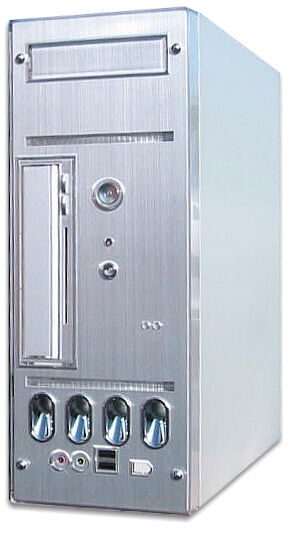
An AMD K6-2 on a Micro ATX motherboard crammed into a small form factor Mini Tower.
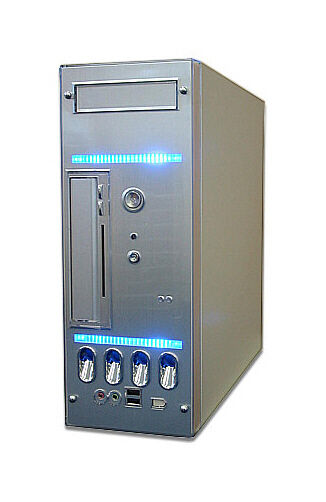
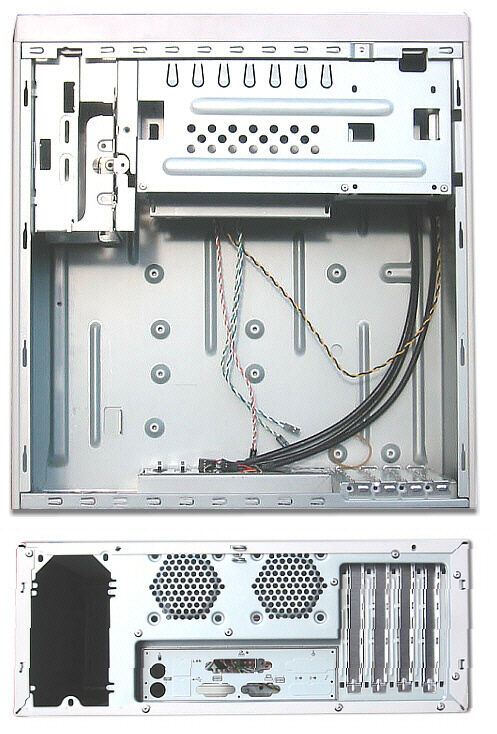
The case is fairly typical of PCs in the early 2000s, with silver trim and LEDs in the front panel, the hidden CD drive is a nice touch, though cooling in this case is a challenge.
Though I do find the case to be aesthetically pleasing.
I've fitted two Noctua fans at the rear to help drag air into the case, but unfortunately there's no mount points near the front for any fans to push air in.
Perhaps, a Super Socket 7 wasn't a good fit for this case as we'll soon see, the K6 chips aren't exactly cool running.
Lets talk about that CPU
Background
The original K6-2, codenamed Chomper was introduced in May 1998 and later the Chomper Extended (CXT) in November of the same year, while the Intel's Pentium 2 "Deschutes" debuted a month earlier in April.
Both variants of the architecture implement MMX and AMD's own 3DNow!
Launch dates and clock speeds
This specific variant (K6-2-500) is an odd-ball given that it didn't appear until August of 1999.
It had strong competition from the slightly older but still performant 450 MHz Pentium 2 and the new Pentium 3 which first appeared in February, the newer K6-3 and the impending release of Athlon.
- The K6-3 at 450 MHz in February, priced at $476.
- The Pentium 3 running at 600 MHz appeared on August 2nd with a price of $670 (See also: Dominator)
- The Pentium 2 clocked at 350 MHz released on April 15th with an initial launch price of $620 but by March 1999 it was lowered to about $476 to match the K6-3.
I'm pretty sure AMD just wanted to make Intel sweat a little by setting the price for its offering at the wallet-friendly price of this CPU at $168.
Architectural comparison
Pipeline length
Pipelining systems attempt to keep every part of the processor busy with some instruction by dividing incoming instructions into a series of sequential steps performed by different processor units with different parts of instructions processed in parallel. Longer pipelines usually allow greater parallelism, but in the event of a stall or bad branch prediction can have a devastating performance impact compared to short pipelines.
- Both the Pentium 2 and K6-2 had a 12 stage pipeline.
- The K6-2 had a non-pipelined Floating Point Unit but Intel's was, giving it an advantage in math heavy applications like 3D games.
Fabrication
Fabrication is process of actually constructing the CPU die, the numerical value e.g. 250nm, is the size of the transistors on the CPU, usually given in Nanometers (nm) or Microns (um).
- The 500 MHz version made in 1999, continued use of AMDs 250nm fabrication process.
- Intel's Deschutes core was also fabricated at this size, by October of '99, Intel had achieved a 180nm process with good yields, higher clocks and lower power consumption.
- AMD eventually switched to 180nm for the Athlon and K6-2+ mobile processors in September 2000.
Cache
A CPU cache is usually a dedicated bank of memory that is very fast and is designed to reduce the average cost (time or energy) to access data from the main memory which can be orders of magnitude slower.
- The K6-2 boasted 64KB of L1 cache, while the Pentium 2 had half that amount.
- With the release of the P2, Intel had taken the knowledge they gained from the Pentium Pro and placed the cache close to the CPU, this time not on the same substrate to massively boost yield, it has its own dedicated backside bus running at either 50% or 100% of the CPU frequency and it resulted in significant performance gains.
- AMD was still forced to rely on L2 cache provided by the main board, if any.
- With the Pentium 3, Intel increased the FSB to 133 MT/s for certain models, further enhancing performance.
Caught in the middle
February 1999 saw the introduction of the K6-3 line up, which borrowed heavily from the K6-2 but this time it also had on-chip L2 cache which greatly increased performance against its older sibling, however it still shared the same Floating Point unit, that combined with the architecture scaling poorly beyond 500 MHz left them trailing Intel once more. But this meant AMDs K6-3 was now in direct competition with itself, given that the K6-2 was priced significantly lower, it seemed odd to launch a budget chip where the performance margin at 500 MHz was only around 20%.
Then in the following October Intel's Coppermine architecture featuring variants with L2 cache running at 100% speed and utilizing the more efficient 180nm fabrication process, with reduced power consumption, with the P3 600E model consuming just 19 watts compared to the 30 watts of the 250nm K6, Uptake of the K6-3 was so poor, that by time Coppermine appeared, the K6-3 was already discontinued and quickly superseded with Athlon.
So in October of 1999, we now we had:
- The Pentium 2, clocking in at 450 MHz
- The K6-2 at 500 MHz
- The newly released Pentium 3 running up to 733 MHz
- And AMDs K6-3 peaking at 450 MHz after all the 500's were recalled due to being unstable.
Conclusion
The AMD line of processors was in serious trouble.
Intel just kept pumping out newer and faster designs every few months, combined with their "Tick Tock" approach to their manufacturing process lead to some serious power savings and profit margins.
The K6-2 seems relegated to being a bargain bin processor with mediocre performance, fortunately for AMD, their luck was about to change, the new Athlon design was about to bare fruit.
Benchmark scores
Ratios for CPU score vs. Clock Speed, higher is better
-
AMD K6-2 @ 500 MHz:
- Ratio: 627 / 500 ≈ 1.254
-
Intel Pentium 2 @ 350 MHz:
- Ratio: 561 / 350 ≈ 1.603
-
Intel Pentium 3 @ 600 MHz:
- Ratio: 969 / 600 ≈ 1.615
Images